
Baby Jesus majesty




Description of the work
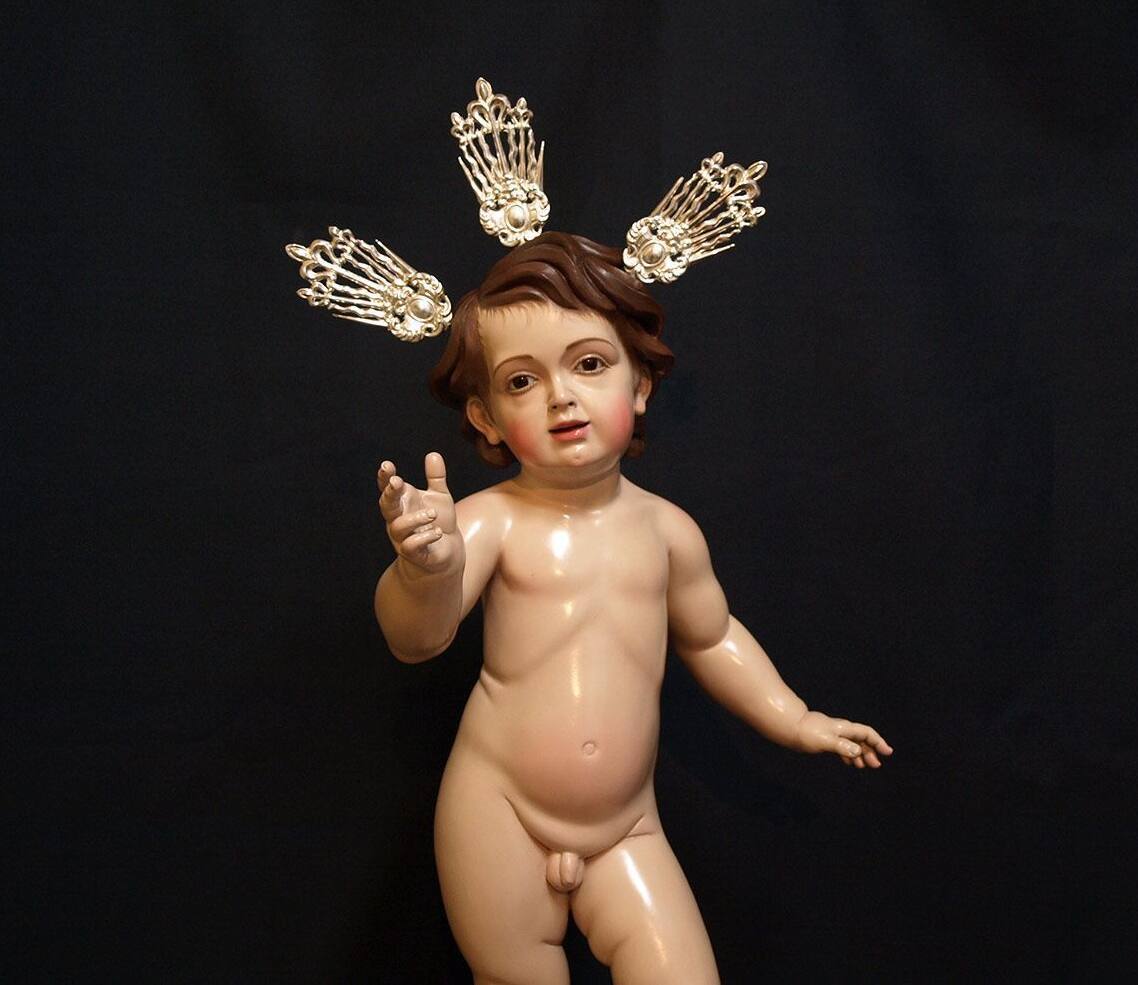
The statue of the Child Jesus in Majesty is a remarkable interpretation of one of the most significant iconographic themes in Christian religious sculpture. Carved from cedar wood, gilded, tempera-ground, and polychromed in oil, this work by the sculptor and religious artist Juan Alberto Pérez Rojas is part of the great tradition of Andalusian religious art, reinterpreting with contemporary sensibility a model deeply rooted in Spanish sacred art.
The figure depicts the Infant Jesus in a triumphant and regal pose, simultaneously revealing his human and divine nature. Standing on a celestial cloud adorned with the heads of winged angels, the composition conveys a visual narrative of profound theological significance. His right hand is raised in a gesture of blessing, while his left arm is positioned in a protective stance, evoking Christ’s redemptive mission from the very moment of his Incarnation. This iconography, common in Spanish Baroque sculpture, underscores the idea of Christ as King of the Universe and Lord of Creation.
One of the most striking aspects of the work is the anatomical study of the child figure. The sculptor creates a naturalistic representation that demonstrates a deep understanding of a child’s anatomy, striking a balance between physical realism and aesthetic idealization. The figure is composed using an elegant contrapposto, a classical device inherited from the Western sculptural tradition, which lends movement, harmony, and stability to the whole. This formal approach ensures that the sculpture remains visually engaging from any vantage point, adhering to an academic criterion of the sculpture’s overall conception.
The treatment of the face deserves special attention, as it is here that much of the work’s expressive power is concentrated. The sweetness of the childlike features, the serenity of the gaze, and the careful rendering of the hair create a sense of intimacy and spiritual contemplation. The strands of hair, rendered with dynamism and a sense of volume, help to reinforce the image’s personality and its capacity for devotional communication.
Polychromy is also an essential element of the artwork. The soft, delicately shaded skin tones enhance the realism of the carving and convey the tenderness characteristic of the iconography of the Infant Jesus. Similarly, the gilding and polychromatic painting visually enrich the work, lending it luminosity and nobility without detracting from the compositional harmony.
The result is a religious sculpture of remarkable artistic quality that draws on the tradition of the great masters of the Sevillian school, keeping alive a sculptural language that remains fully relevant in the 21st century.