
Christ of the True Cross


Description of the work
The "Cristo de la Vera Cruz" by the religious artist Juan Alberto Pérez Rojas is deliberately rooted in the tradition of Andalusian religious sculpture, particularly the Sevillian school, which is a direct heir to the great masters of the Spanish Baroque such as Juan Martínez Montañés and Juan de Mesa. However, far from limiting himself to a simple historicist recreation, the sculptor develops a language of his own based on formal serenity, spiritual depth, and compositional balance.
Devotion to the True Cross
The veneration of the Vera Cruz holds enormous significance within the Spanish religious tradition. Since the late Middle Ages, these brotherhoods, which emerged under the guidance of the Franciscans, promoted a spirituality centered on the contemplation of the Passion of Christ and the exaltation of the Cross as a symbol of redemption. These penitential brotherhoods played a decisive role in the development of processional imagery and in the dissemination of iconographic models of the Crucified Christ in Spain and Latin America.
Within this historical and devotional context, the crucifixion has been one of the most significant representations in Western art. Spanish Baroque sculpture transformed the image of Christ on the cross into a vehicle for religious emotion and spiritual contemplation, capable of uniting naturalism, idealization, and devotional sentiment. The Sevillian school, particularly beginning with Martínez Montañés, developed a style characterized by anatomical elegance, expressive restraint, and the serene beauty of Christ’s body.
Iconography and Composition of the Crucifix
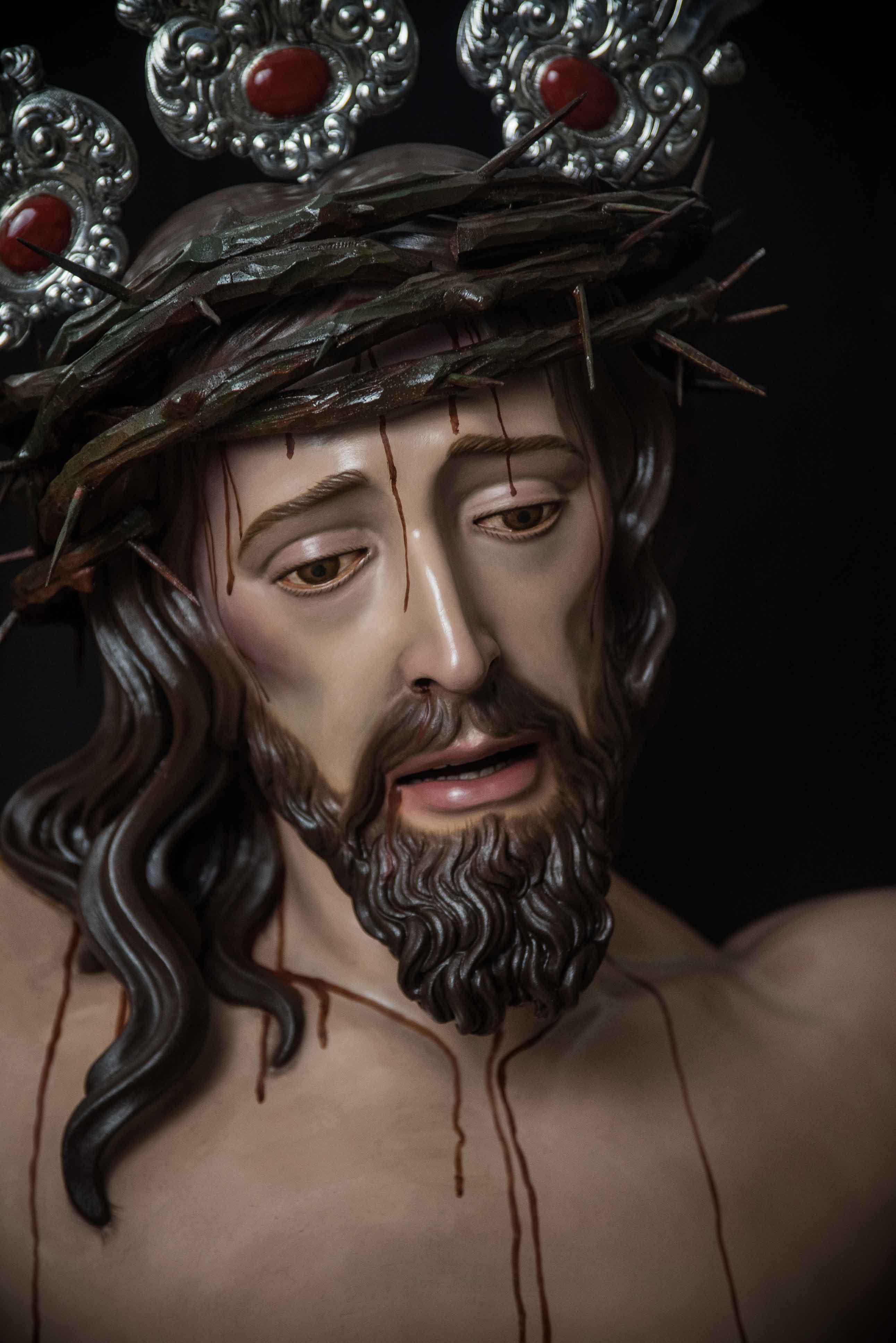
It is precisely within this tradition that Pérez Rojas’s *Cristo de la Vera Cruz* is situated. The sculpture depicts Christ alive, with his head tilted slightly to the right and a carefully rendered anatomical treatment that conveys both humanity and dignity. The body is rendered with a deep understanding of classical anatomy, yet avoids any muscular excess or dramatic sensationalism. The work seeks to move the viewer through harmony and inner contemplation, not through the violent impact of physical suffering.
The composition reveals a clear dialogue with the great 17th-century Sevillian crucifixes. The balanced verticality of the figure and the positioning of the arms recall the aesthetic ideals developed by Andalusian Baroque sculpture, in which Christ’s body was meant to express both human sacrifice and the divine dimension of redemption. In this sense, the work embodies an artistic conception that viewed beauty as a vehicle for spiritual elevation.
The treatment of the face is particularly significant. Far from a tortured expression, the sculptor opts for serene and deeply contemplative features. The open eyes, the delicate modeling of the mouth, and the carving of the beard and hair all contribute to creating an atmosphere of silence and contemplation. This decision connects directly with some of the fundamental principles of the Counter-Reformation, which promoted images capable of emotionally bringing the Christian mystery closer to the faithful through a realistic yet deeply spiritual representation.
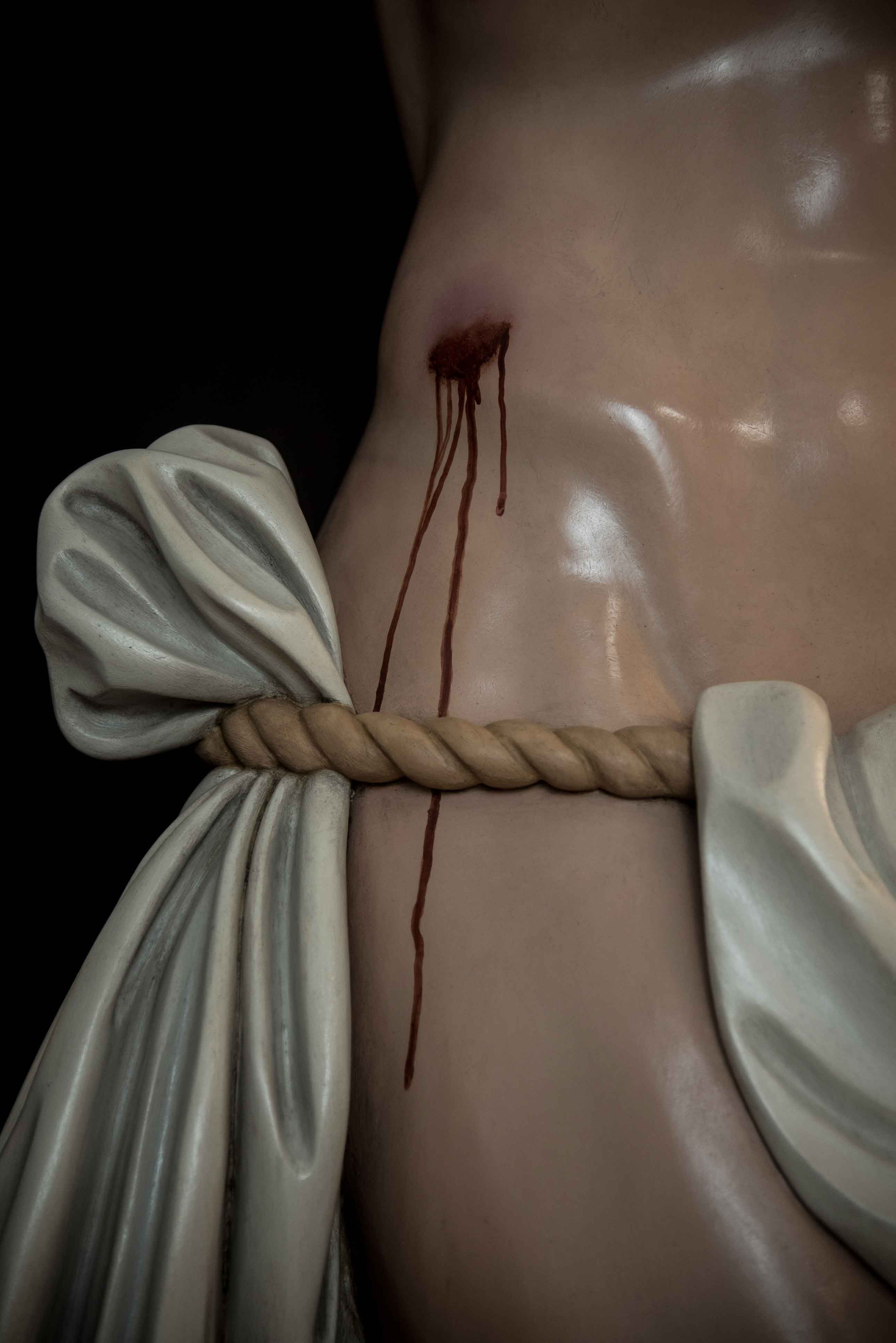
Polychromy also plays an essential role in the work. Following the tradition of Spanish polychrome woodwork, the sculptor creates a sober and nuanced flesh tone, characterized by soft color transitions and a deliberate restraint in the depictions of the martyrdom. In contrast to the bloody drama characteristic of certain Castilian models, Andalusian sensibility has historically tended toward a more elegant and restrained representation of suffering, thus favoring an aesthetic experience based on spiritual beauty and inner contemplation.
The shroud, carved with elegance and dynamism, plays a decisive role in the visual balance of the composition. Its folds not only enrich the work from a sculptural perspective but also help introduce rhythms and contrasts of light that reinforce the figure’s monumental quality. The result is an image of great visual power, conceived for both devotional intimacy and broader artistic contemplation.
In the current landscape of sacred art, Juan Alberto Pérez Rojas’s *Cristo de la Vera Cruz* stands as a significant example of continuity and renewal within contemporary religious imagery. The work demonstrates how the Spanish Baroque tradition continues to serve as a living source of inspiration for today’s sculptors, who are able to reinterpret its aesthetic and spiritual values through a thoroughly contemporary sensibility.
También puede interesarle
Para ampliar el contexto artístico y devocional de esta imagen del Cristo de la Vera Cruz, le invitamos a conocer otras referencias relacionadas con la obra y con la iconografía del Crucificado en la producción de Juan Alberto Pérez Rojas.
Bendición del Cristo de la Vera Cruz de Montequinto
La prensa sevillana recogió la bendición del Cristo de la Vera Cruz de Montequinto, una obra destinada al culto que testimonia la presencia de la imaginería contemporánea en la vida religiosa de las hermandades y comunidades cristianas.
→ Leer la noticia en Diario de Sevilla
Crucificado de la Divina Misericordia
El Crucificado de la Divina Misericordia ofrece otra interpretación de Cristo en la cruz dentro del catálogo de Juan Alberto Pérez Rojas, con una lectura serena, devocional y profundamente vinculada al lenguaje de la imaginería sacra contemporánea.